
Quick Answer: What Is AI-Augmented Software Development?
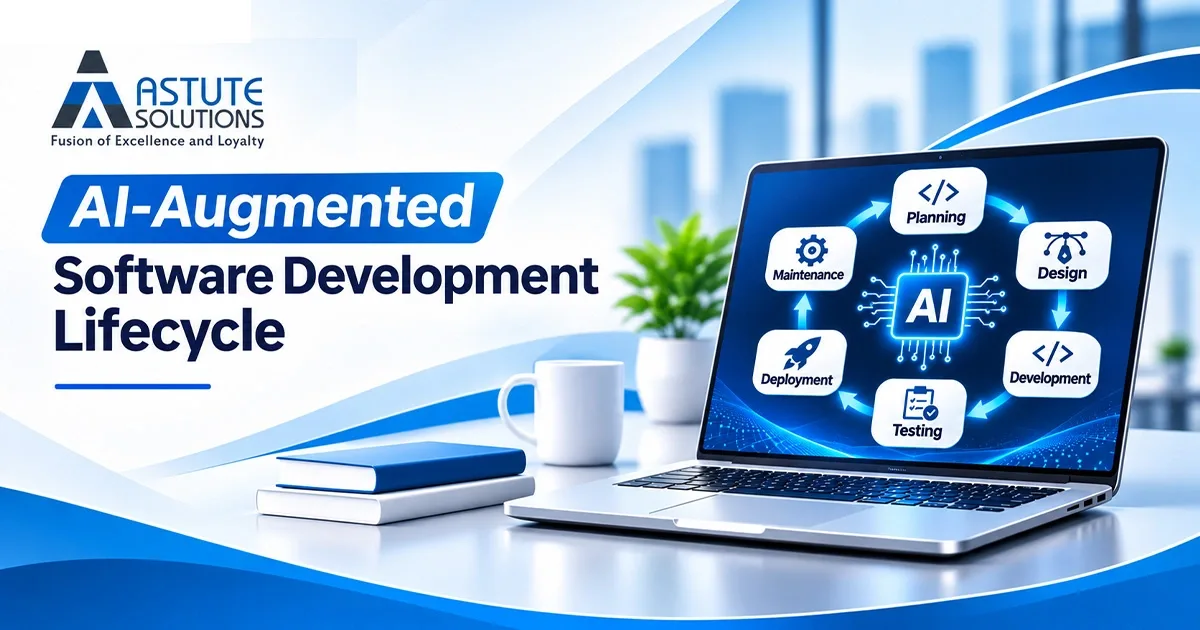
AI-augmented software development is an engineering approach that uses artificial intelligence to assist with product discovery, requirements analysis, architecture research, prototyping, coding, testing, debugging, documentation, deployment preparation, and ongoing maintenance.
AI supports the development process while experienced engineers remain responsible for technical decisions, security, business logic, code quality, and production readiness.
Unlike simply generating an application from a prompt, AI-augmented engineering combines automation with structured requirements, engineering standards, testing, and human review.
At Astute Solutions, this approach supports the development of SaaS platforms, AI-powered applications, custom business software, web and mobile products, and long-term engineering engagements.
Key Takeaways
- AI supports the entire development lifecycle: Its use can extend from initial requirements to post-launch maintenance.
- Human oversight remains essential: Developers must validate AI outputs and retain responsibility for architecture, security, and correctness.
- Business requirements come first: Choosing AI tools before defining a problem can introduce unnecessary complexity.
- Better prototyping does not guarantee production readiness: Authentication, permissions, reliability, and integrations still require careful engineering.
- Testing becomes more important: Fast code generation creates additional demand for review, validation, and regression testing.
- AI is not suitable for every task: Deterministic systems and traditional automation remain appropriate for many requirements.
- Success requires measurable outcomes: Teams should assess delivery time, defect rates, review effort, rework, and user outcomes.
- Astute Solutions combines engineering experience with AI assistance: The company applies AI-supported workflows across product development and engineering engagements.
Understanding the AI-Augmented Software Development Lifecycle
The software development lifecycle, commonly called the SDLC, describes the activities involved in planning, designing, developing, testing, deploying, and maintaining an application. Traditional software engineering methodologies organize these activities into structured processes. The exact implementation may follow Agile, iterative development, continuous delivery, or another suitable approach.
Artificial intelligence introduces new ways to assist engineers within these processes. For example, a developer can use AI to investigate unfamiliar source code, compare architecture alternatives, draft tests, or prepare a prototype. However, the software still needs to satisfy functional and non-functional requirements.
Those requirements may include data security, maintainability, reliability, performance, user accessibility, and integration with existing systems. AI assistance changes how particular tasks are performed. It does not eliminate the need to define and verify the expected results.
AI-Assisted, AI-Augmented, and Agentic Development
These terms describe related but different approaches.
| Approach | Meaning | Example |
|---|---|---|
| AI-Assisted Coding | AI helps with selected coding tasks. | Suggesting a function or explaining an error |
| AI-Augmented Engineering | AI supports multiple development stages under engineering oversight. | Research, implementation, review, and testing |
| Agentic Engineering | AI agents execute connected tasks within controlled tools and workflows. | Proposing code changes and running tests |
| AI-Native Product Development | AI capabilities are part of the product's core design. | Knowledge assistants and document intelligence systems |
The distinction matters because software can be developed using AI-assisted engineering without needing AI as a feature for the end user. For example, a conventional billing platform might be developed with AI coding assistance but still use deterministic calculations for all financial transactions.
Conversely, an intelligent document processing system may use AI as a core product capability while relying on conventional engineering for authentication, databases, and operational workflows.
Stage 1: Product Discovery and Business Requirements
Effective software development starts with understanding the problem, not selecting a technology. A business may want to automate customer onboarding, replace spreadsheets, improve internal reporting, or build a new subscription platform. Before implementation begins, the team must understand the users, the required outcomes, the constraints, and the existing workflow.
How AI Can Support Product Discovery
AI can help engineers organize stakeholder notes, prepare research questions, compare technical options, and identify potential edge cases. It may also assist with analyzing unstructured requirements or drafting an initial feature inventory. These outputs should be treated as starting points for further investigation.
An AI model may identify common requirements for a multi-tenant SaaS platform, but it cannot independently establish which of those requirements apply to the specific business. Astute Solutions' Product Discovery engagement model focuses on defining what should be built, why it matters, and how the product should work.
Practical Example: A Company Wants an AI Customer Portal
Suppose a professional services company wants to develop a customer portal with an AI assistant. The initial request sounds straightforward. However, discovery must answer several questions.
- Which users need portal access?
- What customer records can each user view?
- Which existing systems provide the information?
- What questions should the AI assistant answer?
- Should the assistant retrieve information or perform actions?
- What happens when an answer is uncertain?
- Which operations require human approval?
- How will success be measured?
These questions influence the architecture and implementation scope. AI can assist with documenting possible scenarios, but product owners and engineers must validate the final requirements.
Stage 2: Requirements Analysis and System Architecture
Software architecture defines how an application's components interact, store information, enforce permissions, and support future changes. Architecture becomes particularly important in SaaS platforms, multi-user business applications, financial systems, and software connected to external services.
Where AI Can Help
AI-assisted research can help engineers compare frameworks, identify architectural patterns, evaluate integration approaches, and investigate technical trade-offs. For example, an engineering team might compare different database tenancy models or approaches to background job processing.
However, selecting an architecture requires more than generating a list of possible technologies. The team must consider data isolation, expected workloads, maintenance costs, deployment complexity, security, and the experience of the people who will maintain the software.
What Engineers Must Still Decide
Important architecture decisions include authentication, authorization, database relationships, API contracts, asynchronous processing, data retention, monitoring, and recovery procedures. In an application handling financial transactions, engineers must also evaluate consistency, duplicate requests, failure recovery, and auditability.
Astute Solutions' custom SaaS and software engineering capabilities address applications where these concerns form part of the product foundation.
Engineering principle: AI-generated architecture suggestions are proposals, not verified designs. An engineer must evaluate them against the actual system requirements and explain the resulting trade-offs.
Stage 3: UX Design and Rapid Prototyping
Prototypes help product teams explore workflows before investing in the complete application. A prototype may demonstrate an onboarding journey, dashboard layout, approval process, or mobile interface.
AI tools can assist with creating initial interface concepts and draft implementations. This may allow stakeholders to explore different approaches without treating each concept as a complete production release.
What a Prototype Should Validate
The purpose of a prototype is to answer useful questions.
- Can users understand the navigation?
- Does the workflow match the business process?
- Are important actions easy to find?
- Does the information hierarchy support the user?
- Are there missing steps or unnecessary interactions?
Prototypes can help identify these issues earlier. However, a successful prototype does not prove that the application is secure, scalable, or ready for customer data.
Prototype vs. Production Software
| Area | Prototype | Production Application |
|---|---|---|
| Purpose | Explore an idea | Serve real users reliably |
| Data | Often illustrative | Real data with controls |
| Security | May be limited | Requires appropriate protection |
| Testing | Concept validation | Functional and operational validation |
| Operations | Temporary environment | Monitoring, recovery, and maintenance |
Stage 4: AI-Augmented Coding and Implementation
Implementation is the stage most commonly associated with AI coding tools. Modern systems can generate draft functions, explain existing code, suggest refactoring, and assist with implementation tasks. These capabilities can be useful, especially when developers work within an established codebase and clear requirements. However, generated code is not automatically correct.
Software Development Tasks AI Can Assist With
- Preparing repetitive application structures
- Exploring existing classes and functions
- Generating draft API handlers
- Suggesting database queries
- Preparing validation logic
- Drafting unit tests
- Investigating error messages
- Explaining unfamiliar implementation patterns
- Supporting refactoring and documentation
Each generated change still needs to be reviewed within the application's actual context. For example, AI may generate a customer record endpoint that appears functional but fails to check whether the requesting user is permitted to access that particular customer's information. A developer must identify and correct that problem before deployment.
A Controlled AI-Assisted Coding Workflow
A practical development workflow can follow these steps:
- Define the feature and acceptance criteria.
- Identify existing architectural conventions.
- Provide the AI system with relevant, permitted context.
- Generate or modify a small, reviewable implementation.
- Inspect the resulting code and dependencies.
- Run relevant tests and verify actual behavior.
- Review security, permissions, and exceptional cases.
- Commit the change through the team's normal review process.
This approach makes AI assistance part of a controlled engineering workflow rather than an uncontrolled code-generation experiment. Businesses requiring additional implementation capacity can use dedicated AI-augmented engineering teams to support their existing technology organization.
Stage 5: Testing, Quality Assurance, and Debugging
When development becomes faster, testing and review remain essential. An AI-generated implementation may appear correct while missing important edge cases or misunderstanding the requirements. Testing should verify the expected behavior rather than merely confirm that code executes.
Important Testing Activities
- Unit testing examines individual functions or components.
- Integration testing checks whether multiple systems or components work together.
- End-to-end testing examines complete user workflows.
- Regression testing checks whether new changes unintentionally affect existing behavior.
- Security testing examines relevant risks involving authentication, authorization, sensitive information, and application behavior.
- Performance testing assesses how the system behaves under selected workloads and operating conditions.
Why AI-Generated Tests Need Review
AI can generate test cases and suggest unusual scenarios, but a generated test may simply reproduce the same incorrect assumption found in the implementation. For example, a test might verify that a user can retrieve an invoice without checking whether that invoice belongs to the correct customer account.
The test passes, but the application remains insecure. Engineers must therefore validate the test's intent, assertions, data, and coverage. Research and engineering discussions published by Martin Fowler explore the continuing importance of human judgment, system design, and responsible software delivery as AI tooling evolves.
Stage 6: Security, Privacy, and AI Governance
Security should be considered throughout software development rather than treated as a final checklist. AI-assisted engineering introduces additional considerations because tools may process project instructions, source code, logs, documents, or other contextual information.
Controls Engineering Teams Should Consider
- Limit sensitive information shared with external AI services.
- Apply role-based access and least-privilege permissions.
- Review generated dependencies and third-party packages.
- Validate generated database queries and API behavior.
- Protect credentials, tokens, and environment secrets.
- Use appropriate logging and audit practices.
- Require approval for high-impact production operations.
- Document where AI-generated outputs need human validation.
These are recommended engineering controls; their exact implementation depends on the organization and its operating environment.
Security for AI-Powered Applications
Applications that expose AI features to users may face additional challenges. Examples include prompt injection, unauthorized tool use, disclosure of restricted information, unreliable generated responses, and excessive external API usage. An AI assistant connected to internal records should not gain unrestricted access simply because a user asks it to perform a task.
Permissions must be enforced by the application. Likewise, important transactions should use appropriate validation and approval controls. Astute Solutions' AI systems and automation engineering is positioned around integrating intelligent capabilities into real business applications and workflows.
Stage 7: Deployment, Monitoring, and Production Readiness
Completing the implementation is not the same as completing the software product. Before deployment, engineering teams must consider configuration, infrastructure, database migrations, system monitoring, and recovery procedures. A successful production release should have a defined process for detecting and responding to unexpected behavior.
Production Readiness Checklist
| Area | Required Review | Responsible Role |
|---|---|---|
| Requirements | Acceptance criteria verified | Product owner and QA |
| Security | Access controls and relevant risks reviewed | Engineering and security |
| Testing | Critical workflows and regressions checked | QA and engineering |
| Data | Migrations and recovery considered | Backend and operations |
| Operations | Monitoring, alerts, and rollback plan | Engineering and operations |
| Documentation | Runbooks and ownership established | Engineering team |
The responsibility column provides an illustrative ownership model. Actual roles vary between organizations and engagement structures.
Stage 8: Maintenance and Continuous Product Improvement
Software products evolve after deployment. Customers request features, integrations change, technology dependencies are updated, and operational issues emerge. AI-assisted tools may help developers investigate defects, understand existing code, prepare changes, and update documentation.
However, long-term product success depends on retaining architectural knowledge and making changes without damaging existing functionality.
Common Post-Launch Activities
- Monitoring application reliability
- Investigating production errors
- Updating dependencies
- Improving performance
- Developing new product features
- Maintaining third-party integrations
- Reviewing customer feedback
- Reducing technical debt
- Improving documentation and testing
Astute Solutions supports ongoing engineering through its Continuous Product Development model, allowing businesses to continue improving an application rather than treating launch as the final milestone.
Practical Example: Building a Multi-Tenant SaaS Platform With AI Assistance
Consider a fictional professional services company planning a SaaS platform for project tracking, employee time records, client reporting, and invoice preparation. The platform will support multiple customer organizations, each with separate users and records. AI can assist at several stages, but important decisions must remain under engineering control.
| Stage | AI Assistance | Engineering Responsibility |
|---|---|---|
| Discovery | Drafting workflows and questions | Validating the business requirements |
| Architecture | Comparing tenancy patterns | Ensuring tenant data isolation |
| Design | Generating prototype ideas | Validating usability and workflows |
| Development | Drafting application components | Reviewing business logic and permissions |
| Testing | Suggesting edge cases | Verifying isolation and correctness |
| Deployment | Assisting with runbooks | Approving release and recovery plans |
For example, AI might generate a project reporting endpoint, but the engineering team must verify that the endpoint cannot return information belonging to another customer organization. Similarly, invoice calculations should rely on validated financial and billing rules rather than unconstrained language-model output.
This example illustrates the practical difference between AI-assisted implementation and accountable product engineering. Astute Solutions develops applications with comparable architectural categories through its SaaS and custom software services. The example itself is illustrative, not a claim about an individual customer deployment.
How to Measure the Success of AI-Augmented Development
Organizations adopting AI in software development should assess whether the approach improves delivery outcomes rather than only counting generated code or AI tool usage. Useful measures include lead time for changes, change failure rate, review effort, rework, defect trends, and the quality of delivered features.
Practical Engineering Metrics
| Metric | What It Reveals | Important Limitation |
|---|---|---|
| Lead Time for Changes | How long changes take to reach production | Does not alone prove customer value |
| Change Failure Rate | Frequency of problematic deployments | Requires consistent failure definitions |
| Review Effort | Time needed to verify proposed changes | Varies with complexity and risk |
| Rework Rate | How often work requires correction | Scope changes should be separated |
| Defect Trends | Quality issues over time | Affected by testing and reporting practices |
| User Outcomes | Whether delivered software solves the problem | Needs product-specific success criteria |
For example, a development team might report that implementation time decreased after introducing AI assistance. However, if review time, defects, and rework increased substantially, the overall improvement may be smaller than expected. The appropriate evaluation examines the complete workflow.
Google's DORA research on software delivery performance provides a useful foundation for evaluating development performance beyond code-generation speed.
Common Mistakes in AI-Augmented Software Development
1. Starting With AI Instead of a Business Problem
Using AI simply because it is available may create complexity without solving a meaningful problem. Begin with the required outcome, then determine whether AI, conventional automation, or standard software is appropriate.
2. Accepting Generated Code Without Review
AI-generated code can contain logical errors, insecure assumptions, and unnecessary complexity. Review and testing must remain part of the development workflow.
3. Treating Prototypes as Finished Products
A successful demonstration may not include appropriate permissions, monitoring, error handling, or production infrastructure. Production readiness must be assessed separately.
4. Ignoring Existing Architecture
Generating a new implementation without understanding the current codebase may introduce duplication, inconsistent patterns, or compatibility problems. AI-assisted changes should follow the application's established conventions where appropriate.
5. Measuring Only Coding Speed
Code generation time is only one component of software delivery. Teams should also consider review, integration, testing, deployment, maintenance, and the usefulness of the resulting feature.
6. Automating Sensitive Actions Without Controls
Systems that can change financial records, access customer information, or modify production infrastructure need appropriate authorization and oversight. Giving an AI agent broad access without sufficient constraints creates unnecessary risk.
When Should Businesses Use AI in Software Development?
AI assistance can be valuable when it helps engineers investigate problems, reduce repetitive work, or examine alternatives more effectively. It may be particularly useful for technical research, prototyping, code explanation, test preparation, documentation, and carefully scoped implementation tasks.
However, not every business process requires an AI-based solution. Some requirements are best implemented using deterministic algorithms, established APIs, and conventional workflows. For example, user permission checks and invoice calculations should use reliable application logic.
An AI assistant may help users interact with those systems, but the underlying rules should remain enforceable and verifiable. Astute Solutions' software project consultation process begins with understanding the business objective and identifying an appropriate technical approach.
How Astute Solutions Applies AI-Augmented Engineering
Astute Solutions combines established software engineering practices with modern AI-assisted workflows. Founded in 2006, the company has worked across web, mobile, cloud, SaaS, and business application development. Its current engineering positioning emphasizes experienced developers, AI assistance, human technical oversight, and continuous review. This philosophy applies across several types of development work.
SaaS and Custom Software Products
Multi-tenant SaaS platforms require architecture, access controls, reliable data structures, integrations, and subscription workflows. AI can assist engineers with implementation tasks, but those fundamental requirements still need careful validation.
AI Systems and Business Automation
Businesses may need AI assistants, document intelligence, workflow automation, or integration with large language models. Astute Solutions considers whether the problem calls for AI functionality, conventional automation, or a combination of both.
Web and Mobile Application Engineering
Web and mobile applications require usable interfaces and reliable supporting systems. AI-assisted prototyping and development can support implementation, while engineers must validate behavior across devices and user scenarios.
Dedicated Engineering Teams
Businesses with existing products may need additional developers, technical specialists, or long-term engineering support. Astute Solutions provides dedicated development arrangements for these requirements.
Continuous Product Development
Products change as users provide feedback and business requirements evolve. Astute Solutions supports ongoing engineering, integrations, maintenance, and feature development beyond the initial release.
What Real Software Products Teach Us About Engineering
Different products introduce different technical challenges. Astute Solutions' portfolio includes SaaS platforms, workforce systems, publishing technology, real-time applications, and industry-specific software.
For example,
- ProdSense AI illustrates the importance of connected time records, user permissions, reporting, and desktop-connected workflows.
- LiveGolfScoring demonstrates engineering considerations associated with real-time information and tournament workflows.
- CTRSpace represents publisher-focused product engineering and digital optimization requirements.
- Servidge illustrates the importance of industry-specific software requirements for mobile device repair businesses.
- My Gym Rewards demonstrates the relationship between membership engagement, mobile experiences, and business administration.
These products involve different technical and commercial problems, but all require a clear understanding of their users and workflows. AI can support development tasks within such projects. It does not replace the domain knowledge and engineering decisions that shape the application.
How to Choose an AI-Augmented Software Development Partner
Businesses considering an AI-augmented development partner should evaluate the team's engineering processes, not just the AI tools it uses.
Useful questions include:
- How does the team define requirements before development?
- Who is responsible for architecture and security?
- Where is AI used in the development lifecycle?
- How are generated changes reviewed?
- What automated and manual testing is performed?
- How are sensitive data and credentials protected?
- Can the team work with an existing codebase?
- How are technical decisions documented?
- What happens after deployment?
- How is development quality measured?
The ideal partner should be able to explain where AI adds value, where it introduces risk, and how the team controls those risks.
Final Thoughts
Artificial intelligence is reshaping the software development lifecycle. It can assist with product discovery, technical research, architecture exploration, prototyping, coding, testing, debugging, documentation, and maintenance. However, successful software engineering still requires understanding the business problem, making appropriate architectural decisions, protecting information, validating functionality, and supporting real users.
The objective is not simply to produce more code or automate every development activity. It is to build useful, reliable software through better engineering processes. Astute Solutions combines experienced engineering with AI-assisted workflows to support SaaS platforms, intelligent business applications, web and mobile products, and ongoing product development. AI can accelerate selected engineering tasks. Human expertise determines whether the final product is appropriate, reliable, and ready for real-world use.
Build Better Software With AI-Augmented Engineering
Planning a SaaS platform, custom application, AI integration, or software modernization project?
Astute Solutions combines experienced development teams with AI-assisted workflows to help businesses turn technical requirements into working products.
Discuss Your Project How We Work